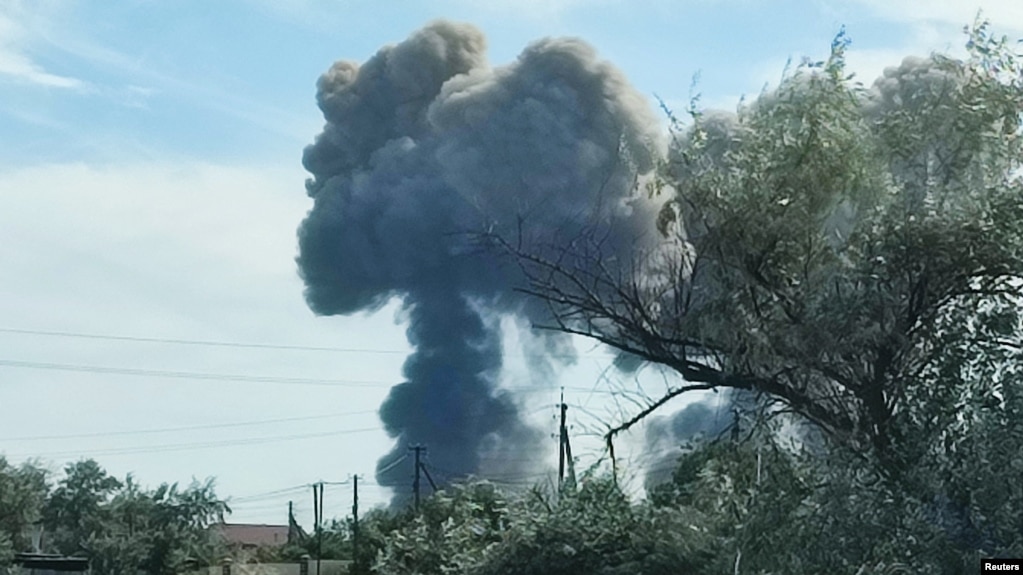
Nổ lớn gần căn cứ không quân Nga trên bán đảo Crimea

https://www.msn.com/en-us/news/world/massive-explosions-rock-russian-base-in-crimea-in-major-blow-to-putin/ar-AA10tLWq?ocid=msedgntp&cvid=8600275e6d26447e8deeb0d377cd8143
Khói bốc lên từ hiện trường vụ nổ

Ba nhân chứng địa phương nói với Reuters rằng họ nghe thấy tiếng nổ lớn và nhìn thấy khói đen bốc lên từ hướng căn cứ không quân của Nga tại Novofedorivka trên bán đảo Crimea bị sáp nhập hôm 9/8.Các đoạn video được nói là ghi lại hình ảnh hiện trường, trong đó có một số đoạn được đăng trên mạng xã hội và được quay từ các bãi biển du lịch gần đó, cho thấy một cột khói. Reuters không thể kiểm chứng ngay về các đoạn băng này.

Người ta nghe thấy ít nhất 12 vụ nổ với mức độ khác nhau trong một phút vào khoảng 15h30, giờ địa phương, hai nhân chứng cho biết. Ba tiếng nổ đặc biệt lớn, phát ra các tia lửa và khói.

Khoảng 30 phút sau, một vụ nổ nữa, được các nhân chứng mô tả là lớn nhất, đã gây ra thêm hai đám khói bụi. Ở thị trấn Saky gần đó, còi báo động vang lên.

Thống đốc Crimea của Nga, ông Sergei Aksyonov, viết trên tài khoản Telegram của ông rằng ông đã đến khu vực này và ‘mọi việc đang được làm rõ’.

Một cố vấn của ông Aksyonov xác nhận rằng đã xảy ra các vụ nổ nhưng từ chối bình luận về nguyên nhân khả dĩ, các hãng thông tấn Nga đưa tin.

Công tác cứu hộ khẩn cấp đã được triển khai, hãng thông tấn TASS đưa tin, dẫn nguồn từ bộ y tế của khu vực.

Người dân địa phương cho biết con đường dẫn ra khỏi bờ biển bị tắc nghẽn.

Nga trong nhiều thập kỷ đã được Kyiv cho thuê quân cảng Sevastopol, căn cứ của Hạm đội Biển Đen, nhưng hồi năm 2014 họ đã sáp nhập toàn bộ bán đảo này từ tay Ukraine trong động thái không được hầu hết các nước công nhận.

Cho đến nay, Crimea đã tránh được bắn phá dữ dội vốn diễn ra ở các khu vực khác ở miền đông và miền nam Ukraine kể từ ngày 24/2, khi Tổng thống Nga Vladimir Putin ra lệnh quân đội Nga tiến vào Ukraine – bao gồm một số đơn vị đóng trên bán đảo Crimea.

Comments

Popular posts from this blog

U.S. vows second warship for Philippines

Chiến hạm BRP Gregorio del Pilar cuả HQ Philippines By Jim Gomez - The Associated Press MANILA, Philippines — The United States will provide a second warship to the ill-equipped Philippine military as it confronts China in increasingly tense territorial disputes in the South China Sea, a Philippine official said Thursday. U.S. Secretary of State Hillary Rodham Clinton assured Defense Secretary Voltaire Gazmin during talks in Manila on Wednesday that Washington would give its longtime ally a second Coast Guard cutter virtually for free some time next year. The first second-hand cutter from the U.S. Coast Guard sailed into Manila in August and became the most modern vessel in the dilapidated Philippine fleet. Clinton assured the Philippine military of intensified U.S. assistance Wednesday when the allies marked the 60th anniversary of the signing of their Mutual Defense Treaty aboard a U.S. Navy destroyer in Manila.

Chinese Support for North Vietnam during the Vietnam War: The Decisive Edge

by Bob Seals   “Best turn it into a bigger war…I’m afraid you really ought to send more troops to the South…Don’t be afraid of U.S. intervention, at most it’s no worse than having another Korean War. The Chinese army is prepared, and if America takes the risk of attacking North Vietnam, the Chinese army will march in at once. Our troops want a war now.” [1] -- Mao speaking to the North Vietnamese in 1964

Questions & Answers_Bill Laurie

Will be speaking to college VN class this week.  They've already submitted 17 questions, answers to which I've since emailed back to their instructor, a USAF VN veteran with history Ph.D.  The presentation will touch on some of these topics and issues but will include much more than contained in these answers.  Here are the questions and answers..... 1. What do you feel the television media effects were on not only the soldiers, but the Vietnamese people as well? It's arguable that television/media coverage had little direct effect on troops, and less so on Viet Namese people, because they didn't see much of it.  It had a huge cumulative indirect effect on both because "news"(?), shallow and biased as it was, did effect people in U.S., both amongst general public and elected officials and decision makers.  The effect was detrimental.